Engine Sensors 101
Beginner → Intermediate · 12 questions
Learn the major engine-management sensors, the normal values they should read, and how to test each one with a multimeter and scan data before you replace it.
-
1. On a properly working closed-loop engine at idle, what does a healthy upstream NARROWBAND oxygen sensor signal do when you watch it on a scan tool?
- A. Rapidly switches up and down between roughly 0.1 V and 0.9 V ✓
- B. Holds a steady voltage right around 0.45 V
- C. Climbs slowly to 5.0 V and stays there
- D. Reads a flat 0.0 V the entire time
Answer: A — Rapidly switches up and down between roughly 0.1 V and 0.9 V. A good narrowband O2 sensor constantly 'switches' (cross-counts) between about 0.1 V (lean) and 0.9 V (rich) as the PCM trims fuel back and forth across stoichiometric. A signal stuck near 0.45 V (the bias voltage) or that switches lazily/slowly usually means a dead or contaminated sensor. The practical takeaway: a healthy upstream sensor is busy, not lazy.
-
2. How does a WIDEBAND (air-fuel-ratio) sensor differ from a traditional narrowband oxygen sensor?
- A. It only works once the engine is cold
- B. It reports a precise air-fuel ratio across a wide range instead of just switching rich/lean ✓
- C. It needs no heater circuit to operate
- D. It outputs a 0-12 V analog signal the PCM reads directly
Answer: B — It reports a precise air-fuel ratio across a wide range instead of just switching rich/lean. A narrowband sensor essentially only tells the PCM 'richer or leaner than stoich.' A wideband (AFR) sensor uses a pump-cell current to measure the actual air-fuel ratio over a broad range (very rich to very lean), which lets the PCM control fueling far more precisely. On a scan tool you read it as an equivalence ratio (lambda) or AFR, not a switching 0.1-0.9 V trace. Takeaway: don't expect a wideband to 'switch' like an old sensor.
-
3. A V6 throws a P0171 and P0174 (system too lean, both banks) with a long-term fuel trim of +25%. The MAF reads lower grams/second than expected for the rpm. What is the most likely cause to check first?
- A. A stuck-open thermostat
- B. A failed knock sensor
- C. A dirty or failing mass air flow (MAF) sensor under-reporting airflow ✓
- D. A shorted camshaft position sensor
Answer: C — A dirty or failing mass air flow (MAF) sensor under-reporting airflow. P0171 is system-too-lean bank 1 and P0174 is system-too-lean bank 2; lean codes on BOTH banks point to something all cylinders share — intake air metering or a big vacuum leak. A contaminated MAF under-reports airflow, so the PCM injects too little fuel and trims positive to compensate. Compare measured g/s to a known-good value (often only a few g/s at warm idle, rising roughly with load/rpm). Takeaway: clean/verify the MAF and rule out unmetered air before condemning O2 sensors.
-
4. What does a MAP (manifold absolute pressure) sensor measure, and how is it used on a speed-density system?
- A. Exhaust back-pressure, to detect a clogged catalytic converter
- B. The pressure of fuel at the rail
- C. Atmospheric humidity, to adjust spark timing
- D. Intake manifold absolute pressure (engine load/vacuum), used with rpm and air temp to calculate airflow ✓
Answer: D — Intake manifold absolute pressure (engine load/vacuum), used with rpm and air temp to calculate airflow. A MAP sensor reads absolute pressure inside the intake manifold. High vacuum at idle = low absolute pressure (low MAP voltage on a typical analog sensor); wide-open throttle = near-atmospheric pressure (high MAP voltage). On a speed-density system the PCM combines MAP, rpm, and intake air temp to calculate the air charge instead of using a MAF. Takeaway: MAP is a load sensor; sanity-check it against engine vacuum at idle vs. snap throttle.
-
5. An ECT (engine coolant temperature) sensor is a thermistor. As the coolant gets HOTTER, what happens to its resistance on a typical sensor?
- A. Resistance falls ✓
- B. Resistance rises
- C. Resistance stays fixed; only voltage changes polarity
- D. Resistance oscillates with rpm
Answer: A — Resistance falls. Most ECT and IAT sensors are negative-temperature-coefficient (NTC) thermistors: resistance drops as temperature rises. Cold, an ECT might read tens of thousands of ohms; fully warm it may be only a few hundred. You can verify it by measuring resistance at a known temperature against the spec chart. Takeaway: hotter = lower ohms = lower signal voltage on an NTC sensor.
-
6. A car runs rich and gets poor fuel economy. Scan data shows the ECT reads -40° even though the engine is fully warmed up. What does that tell you?
- A. The engine is genuinely overheating
- B. The ECT circuit is likely open (broken wire or failed sensor), defaulting to an extreme value ✓
- C. The thermostat is stuck open and must be replaced
- D. The MAF sensor is over-reporting airflow
Answer: B — The ECT circuit is likely open (broken wire or failed sensor), defaulting to an extreme value. -40° is a classic 'rail' value the PCM reports when the ECT circuit is open — the signal voltage pegs and the temperature math defaults to the extreme (note -40°F and -40°C are the same point). A PCM that thinks the engine is freezing commands extra fuel (like a perpetual cold start), causing a rich condition. Back-probe the sensor and check for an open in the signal or ground wire before buying a sensor. Takeaway: extreme pegged readings usually mean a circuit fault, not real temperature.
-
7. You back-probe a TPS (throttle position sensor) signal wire and slowly sweep the throttle from closed to wide open while watching live data. What indicates a GOOD sensor?
- A. The voltage jumps straight from 0 V to 5 V with nothing in between
- B. The voltage stays pinned at 2.5 V no matter where the throttle is
- C. A smooth, steady rise (e.g. ~0.5 V closed to ~4.5 V wide open) with no momentary drops or spikes ✓
- D. The reading only changes after the engine reaches operating temperature
Answer: C — A smooth, steady rise (e.g. ~0.5 V closed to ~4.5 V wide open) with no momentary drops or spikes. A TPS is a potentiometer (variable resistor). Swept slowly it should climb smoothly from a low closed-throttle voltage (around 0.5 V) to a high wide-open voltage (around 4.5 V). Momentary dropouts, dead spots, or spikes mean a worn resistive track, which can cause surging, hesitation, or erratic shifts. Watching graphed live data or an analog meter catches glitches a digital meter's update rate can miss. Takeaway: smoothness matters as much as the end values.
-
8. On many engines, which sensor's signal is the one the PCM absolutely needs to fire spark and pulse the injectors — so that losing it typically causes a crank-but-no-start?
- A. The intake air temperature sensor (IAT)
- B. The knock sensor
- C. The downstream oxygen sensor
- D. The crankshaft position sensor (CKP) ✓
Answer: D — The crankshaft position sensor (CKP). The crankshaft position sensor tells the PCM engine rpm and piston position; without it most engines won't generate spark or injector pulses, so they crank but never start. A failing CKP can also cause stalling or intermittent no-starts, often worse when hot. Takeaway: on a no-spark/no-start, checking CKP signal (and its reluctor/tone wheel) is a high-priority test.
-
9. What is the primary job of the CAMSHAFT position sensor (CMP) on a modern sequential-injection engine?
- A. To identify which cylinder is on its compression stroke so injection/spark can be sequenced (and to support variable valve timing) ✓
- B. To measure exhaust oxygen content
- C. To meter the mass of incoming air
- D. To sense detonation and retard timing
Answer: A — To identify which cylinder is on its compression stroke so injection/spark can be sequenced (and to support variable valve timing). The cam sensor gives the PCM cylinder identification — it tells which cylinder is coming up on compression so the PCM can fire injectors and coils in the correct sequence, and it's used to monitor/control variable valve timing. Lose the cam signal and many engines still start (using the crank signal in a limp 'batch-fire' mode) but may be hard-starting or set a P0340-type code (camshaft position sensor circuit). Takeaway: CKP = is it turning and where; CMP = which cylinder and cam timing.
-
10. What does a knock sensor actually do, and how does the PCM respond to its signal?
- A. It measures coolant temperature and richens the mixture when hot
- B. It detects the vibration/sound of detonation (pinging) and the PCM retards ignition timing to stop it ✓
- C. It counts crankshaft revolutions to set injector timing
- D. It measures intake vacuum to calculate load
Answer: B — It detects the vibration/sound of detonation (pinging) and the PCM retards ignition timing to stop it. A knock sensor is essentially a tuned microphone/piezo that 'hears' the high-frequency rattle of detonation. When it reports knock, the PCM retards spark timing a few degrees to protect the engine, then advances again once knock clears. A bad sensor or unaddressed real knock can cause a P0325-type code (knock sensor 1 circuit), reduced power, or in severe cases engine damage. Takeaway: the knock sensor protects the engine by trimming timing — confirm real detonation vs. a sensor/wiring fault before replacing.
-
11. Which statement about IAT (intake air temperature) data is correct?
- A. IAT should read far below ambient air temperature with the engine off after an overnight soak
- B. IAT directly measures the mass of air entering the engine
- C. After a cold soak, IAT should read close to the ECT and to ambient air temperature; the PCM uses IAT to fine-tune fuel and timing for air density ✓
- D. IAT has no effect on fueling and is only logged for diagnostics
Answer: C — After a cold soak, IAT should read close to the ECT and to ambient air temperature; the PCM uses IAT to fine-tune fuel and timing for air density. After the car sits overnight, IAT, ECT, and ambient should all read within a few degrees of each other — a quick sanity check that both temp sensors are sane. Cold, dense air carries more oxygen, so the PCM leans on IAT to trim fuel and timing for air density. A skewed IAT can shift fuel trims and timing. Takeaway: compare IAT, ECT, and ambient on a cold start — they should agree.
-
12. What is the single most important habit when a code points at a specific sensor?
- A. Replace the named sensor immediately, since the code names the part that failed
- B. Clear the code and assume it was a fluke
- C. Replace all related sensors at once to be safe
- D. Verify the sensor and its wiring/connector with live data and a meter first — the code names the affected circuit, not always a bad part ✓
Answer: D — Verify the sensor and its wiring/connector with live data and a meter first — the code names the affected circuit, not always a bad part. A DTC describes a circuit or condition, not a guaranteed bad component. A 'MAF' or 'O2' code can be caused by wiring, connectors, vacuum leaks, fuel issues, or a skewed reading from another sensor. Back-probe, compare live data to spec, and check grounds/connectors before spending money. Takeaway: verify before you replace — it's the difference between a fix and an expensive guess.
Codes covered in this quiz
Look up the full diagnosis, causes, and fixes for any code these questions reference:
Want to go deeper?
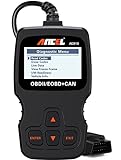
Reputable study materials and a scan tool to actually master this — honest picks, not filler.
Affiliate links — we earn a commission at no extra cost to you.
Want to look up a specific code? Browse all OBD-II codes · Read the repair guides · More quizzes
Educational use only. Always follow your vehicle's service information and safety precautions when diagnosing or repairing.